
OW WE IMPROVE PERFORMANCE
Livestock performance is a system outcome.
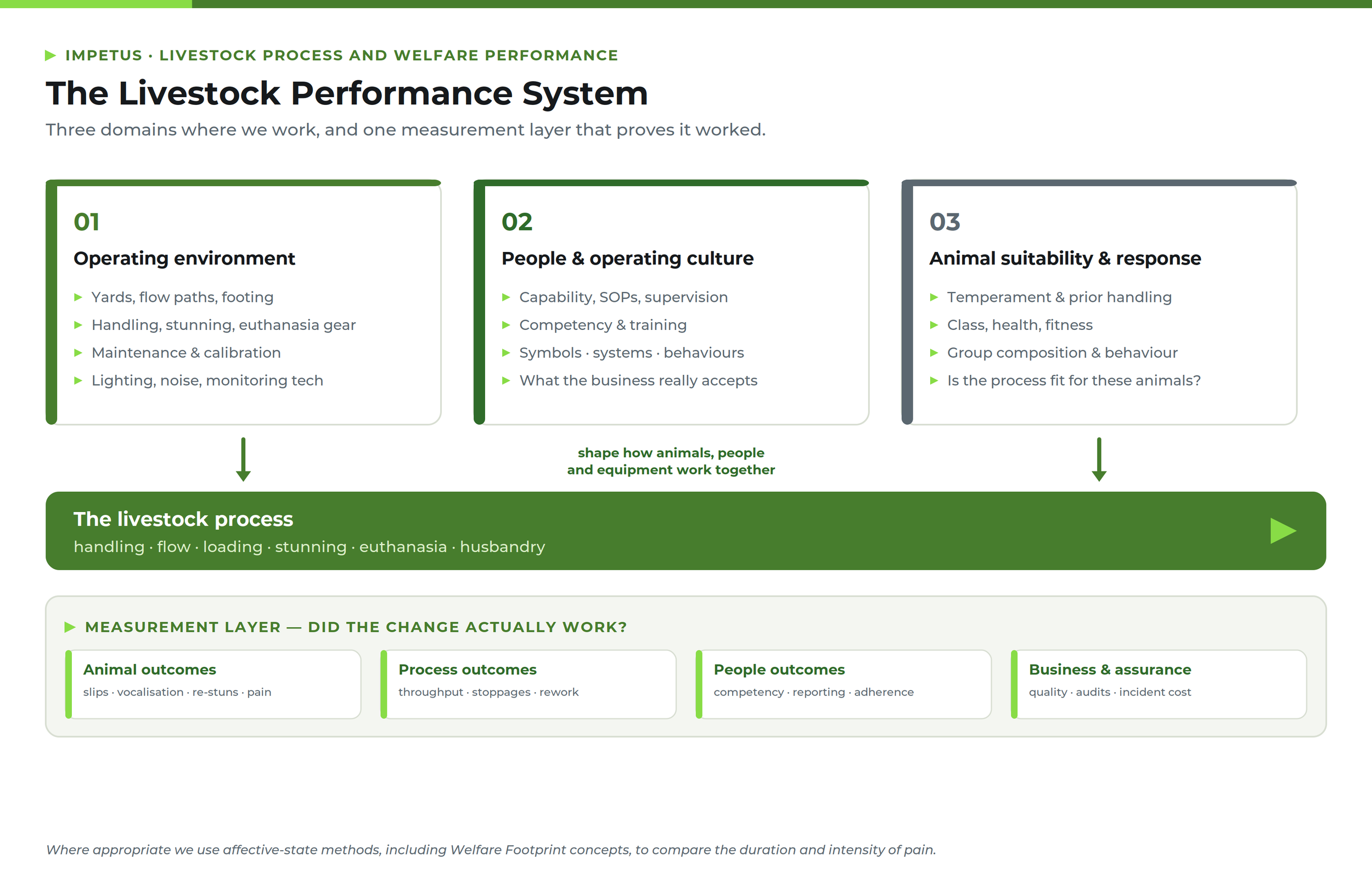
It depends on the operating environment, the capability and culture of the people, the suitability and responses of the animals, and the quality of the measures used to guide decisions. We help organisations understand that system, improve it in practice, and verify whether the change produced better outcomes for animals and the operation.
The operating environment
The physical and technical conditions in which the process happens: yard and facility design, movement pathways, restraint and handling equipment, stunning and euthanasia equipment, maintenance and calibration, lighting, flooring, noise, pain-relief products and monitoring technology.
People and operating culture
Two things that interact. Capability — knowledge, skills, training, SOPs, supervision and competency. And Culture — the stories, assumptions and informal rules that shape how work is actually performed, not merely how procedures say it should be. We work with a simple model: what people see, plus what the system rewards, plus what leaders do, equals what the organisation comes to accept.

Animal suitability and response
Temperament, genetics, prior handling, class, health and behavioural response all affect how a process runs. We assess whether the animals, operating conditions and intended process are appropriately matched — the point is a process fit for the animals entering it, not “fixing” the animal.
Measurement — did it actually work?
We measure across four categories: animal outcomes (slips, vocalisations, ineffective stuns, injuries, pain duration and intensity), process outcomes (throughput stability, stoppages, rework), people outcomes (competency, reporting, corrective-action closure) and business and assurance outcomes (product quality, audit performance, incident costs). Where appropriate we use affective-state methods, including Welfare Footprint concepts, to compare the duration and intensity of negative experiences such as pain.
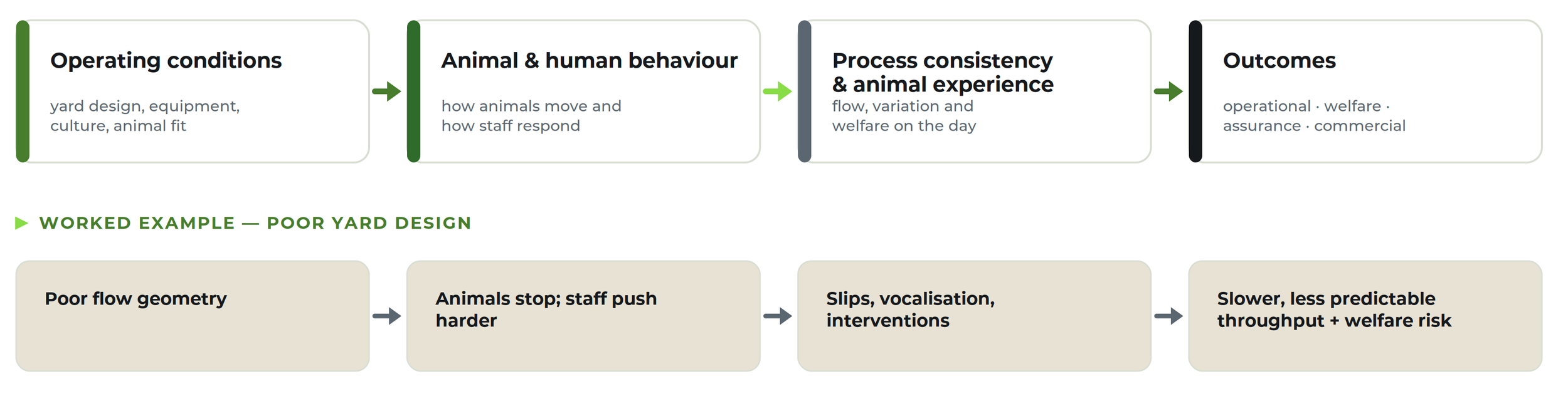
Poor flow geometry → animals stop or turn → staff apply more pressure → more slips, vocalisation and handling → slower, less predictable throughput and greater welfare risk. Welfare and production are not competing subjects. They often come from the same conditions.
Contact us
Interested in working together? Fill out some info and we will be in touch shortly. We can’t wait to hear from you!